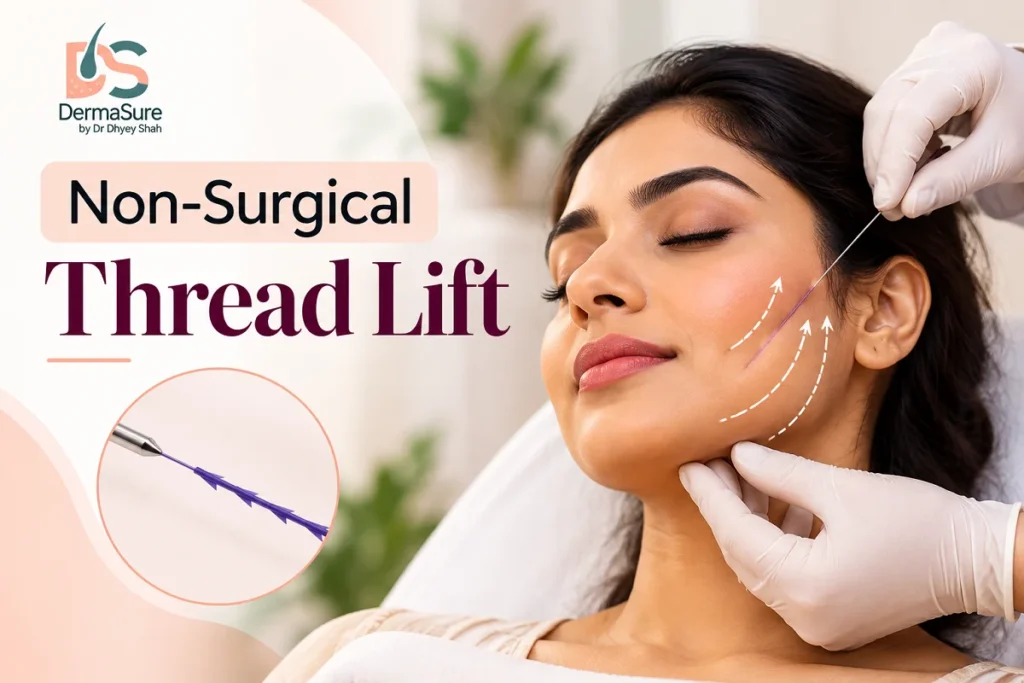
A thread lift is a minimally invasive cosmetic procedure that uses specially designed medical threads placed beneath the skin to create a subtle lifting effect and, depending on the thread type, stimulate collagen production. If you are researching thread lift cost, the honest answer is that it depends on the type and number of threads and the areas treated, so a fair price is only possible after a proper assessment.
At Dermasure in Ahmedabad, Dr. Dhyey Shah performs thread lifts using PLCL threads, and this guide covers what the treatment does, what to expect, and how to compare prices sensibly.
Unlike a traditional facelift, a thread lift does not involve surgical skin removal or long recovery. It is still a medical procedure done through tiny entry points, so it should be planned and performed by a qualified doctor.
What Is Thread Lift Treatment?
A thread lift treatment is a minimally invasive aesthetic procedure designed to provide a temporary lifting or tightening effect to areas with mild to moderate skin laxity.
During treatment, a doctor places fine absorbable threads under the skin. Depending on the design, the threads can support the tissue mechanically and also trigger a healing response that leads to new collagen.
Thread lifts may be considered for areas such as:
- Cheeks and midface
- Jawline
- Jowls
- Eyebrows
- Neck
The exact treatment area depends on facial anatomy, skin laxity, the thread system being used and the doctor’s assessment. The American Society of Plastic Surgeons lists early facial laxity, jowls, sagging eyebrows and early neck laxity among the concerns it can address.
Is a thread lift completely non-invasive?
Not entirely. “Non-surgical” means there is no facelift-type surgery, cuts or stitches on the face; it does not mean nothing enters the skin.
Threads are introduced through small entry points using a needle or cannula. Local anesthesia is commonly used to keep the procedure comfortable.
What Are PDO Threads, and What Are PLCL Threads?
PDO stands for polydioxanone, a synthetic absorbable suture material used in medicine. PDO threads were widely used in thread lifts for many years and can be smooth (mainly for skin quality) or barbed (for lifting).
What are PLCL threads?
PLCL is poly(L-lactide-co-ε-caprolactone), an absorbable copolymer that has long been used in medical sutures. Published reviews describe PLCL barbed threads as a well-tolerated way to reposition sagging facial and neck tissue, with mostly minor and reversible side effects, and the material is generally reported to stay in the tissue longer than PDO. Dermasure now uses PLCL threads for thread lift treatments.
How do these threads work?
The effect can involve two mechanisms:
- Mechanical support: Barbed threads grip the tissue and hold it in a lifted position.
- Collagen response: The thread triggers a gentle healing response around it, which can build new collagen and improve firmness over time.
The extent of lifting and how long it lasts vary with thread type, technique, treatment area and individual factors.
How Does a Non-Surgical Thread Lift Work?
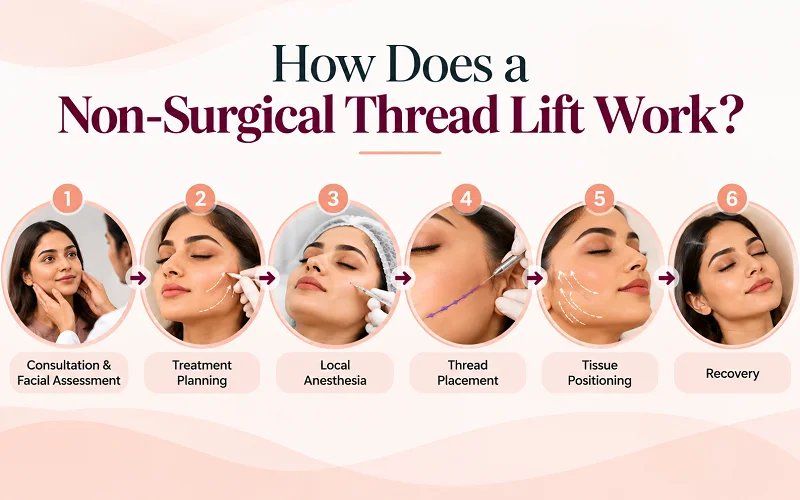
Treatment follows these steps:
- Consultation and facial assessment: skin laxity, facial structure and your goals are assessed, and your medical history and medicines are reviewed.
- Treatment planning: the number, type and placement of threads are chosen for your anatomy.
- Local anesthesia: numbing keeps you comfortable.
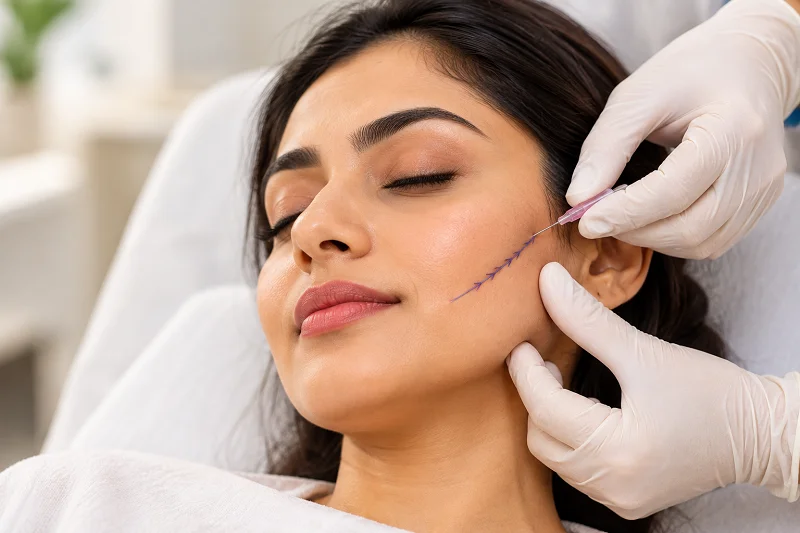
- Thread placement: threads are introduced beneath the skin through small entry points using needles or cannulas.
- Recovery: most patients have very little visible downtime. In Dr. Shah’s practice, noticeable swelling or bruising is seen in about 1 in 10 patients, and it usually settles within a few days.
Technique varies between thread systems and areas, so every treatment is planned individually.
Thread Lift Benefits
The main advantages are:
- Subtle, natural-looking lift of early or mild sagging, without the dramatic change of surgery.
- Minimally invasive: small entry points instead of surgical incisions.
- Collagen stimulation: the healing response around the threads may improve skin firmness over time.
- Little downtime: Cleveland Clinic notes that most people can return to work immediately after a thread lift.
- Targeted treatment: jawline, cheeks, jowls, brows or neck can be treated as needed.
Results depend on your anatomy and on how well the treatment is planned.
How Much Does a Thread Lift Cost in India?
There is no fixed thread lift price, because treatment plans differ from patient to patient. At Dermasure, a non-surgical facial thread lift generally costs ₹15,000–₹60,000, depending on the treatment area and complexity. The final quote is confirmed after a consultation.
Thread lift cost mainly depends on:
- Thread material and design (for example PDO or PLCL, smooth or barbed)
- Number of threads needed
- Treatment area (jawline, cheeks, brows, neck)
- Doctor’s experience and the clinic’s sterile set-up
- Any additional treatment advised, such as fillers for volume loss
A price seen online is only a rough guide, not a personal quote.
When comparing quotes, ask what is included: the type and number of threads, consultation, follow-up visits and aftercare. A very low price may mean fewer threads or a different thread type, so compare like with like.
What Results Can You Expect From a Thread Lift?
Thread-lift results are generally intended to be subtle rather than equivalent to a surgical facelift. You may see a lift soon after treatment, and the finished look becomes clearer over the following weeks as any swelling settles. Individual outcomes cannot be guaranteed.
Right after treatment you may notice mild swelling, tightness or slight asymmetry. These usually settle, so judge the result after healing, not on day one.
How Long Does a Thread Lift Last?
Thread lift results can last for around one to three years. The lifting effect gradually starts to reduce after the second or third year, depending on the thread material, treatment area, and individual factors.
Factors that influence how long results last:
- Thread type
- Number of threads and placement technique
- Degree of skin laxity and skin quality
- Age, lifestyle and individual healing
The threads dissolve gradually, while the collagen they stimulate can help results last a little longer. A thread lift does not stop natural aging, and it can be repeated when you want to maintain the result.
Thread Lift Recovery: What to Expect
Recovery varies with the area treated and the number of threads. Most people return to routine work quickly. Possible early effects are:
- Mild swelling or bruising
- Soreness or tightness
- Sensitivity around entry points
Exercise after a thread lift
Cleveland Clinic notes that a doctor may advise waiting up to two weeks before vigorous exercise or activities that could loosen the threads. Follow the instructions your own doctor gives you, as they depend on the procedure performed.
Simple aftercare tips
Your doctor may advise you to temporarily:
- Avoid exaggerated facial movements and rubbing or pressing the treated area
- Sleep with your head slightly raised
- Attend your follow-up visit
Do not stop any prescribed medicine without asking your doctor. If you have a wedding or event coming up, plan the treatment at least a couple of weeks ahead so any bruising has time to settle.
Who May Be Suitable for a Thread Lift?
Thread lifts are generally considered for people with early or moderate signs of facial laxity who want a relatively subtle improvement without undergoing traditional facelift surgery. Cleveland Clinic describes people with early signs of aging and realistic expectations as typical candidates.
Suitability depends on your degree of skin laxity, facial anatomy and skin quality, your goals, your medical history and any previous cosmetic treatments.
If you are looking for a dramatic correction of heavy sagging, your doctor may suggest another option. A consultation gives a much clearer answer than photographs or online descriptions.
Thread Lift vs. Surgical Facelift
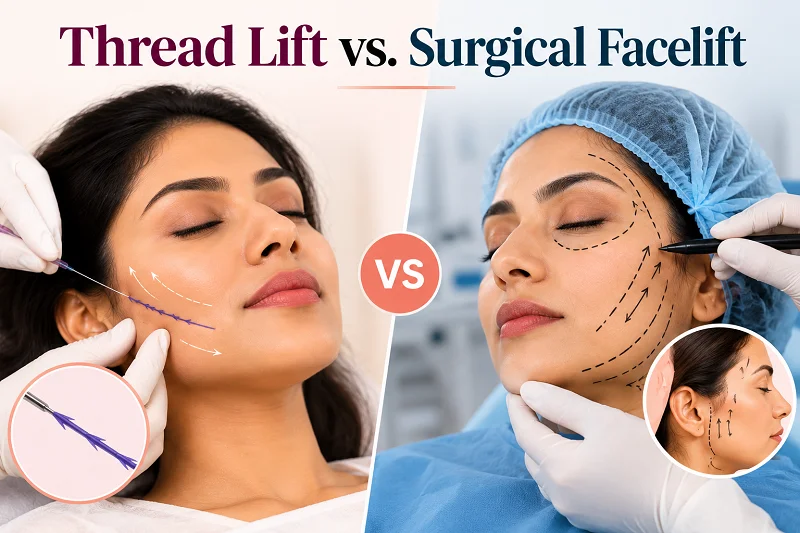
| Thread Lift | Surgical Facelift |
| Minimally invasive | Surgical procedure |
| Threads placed beneath the skin | Surgical tissue repositioning |
| Subtle lift | More substantial correction |
| Little downtime | Longer surgical recovery |
| Results are temporary (about 1–3 years) | Results generally last longer, though aging continues |
| Suited to early or mild laxity | May suit more advanced laxity |
The two are not interchangeable; the right choice depends on how much laxity you have and what result you want.
Is a Thread Lift Safe?
Cleveland Clinic describes thread lift as a low-risk procedure with minimal complications, and published PLCL thread reviews report mostly minor, reversible side effects. Safety still depends on the right patient selection, sterile technique and an experienced doctor.
Choosing Where to Get a Thread Lift
Thread placement needs sound knowledge of facial anatomy, so choose a qualified doctor. Dr. Dhyey Shah is a dermatologist who performs thread lifts at Dermasure, Ahmedabad.
Before you decide, ask:
- Which thread type will be used, and how many?
- What result can I realistically expect?
- What are the possible complications, and what happens if one occurs?
- What is included in the quoted price?
Frequently Asked Questions About Thread Lift Treatment
What is the price of a thread lift at Dermasure?
In India, a non-surgical facial thread lift generally costs ₹35,000–₹75,000+, depending on the treatment area and complexity. The exact quote is given after a consultation with Dr. Shah. [Please review given pricing details]
How long does a thread lift last, and is it permanent?
It is not permanent. Cleveland Clinic reports results lasting about one to three years, depending on the threads used and the individual. Natural aging continues, and the treatment can be repeated.
What are the side effects and limitations?
The lift is temporary and subtle. Some people have short-term swelling, bruising or tightness (about 1 in 10 patients in Dr. Shah’s practice. Dimpling, infection or a visible thread are uncommon.
Is a thread lift painful?
Local anesthesia is used, so the procedure is done comfortably. Some tenderness or tightness can be felt for a few days afterwards.
Is a thread lift the same as a facelift?
No. A thread lift is minimally invasive and gives a subtle, temporary lift. A surgical facelift is a bigger operation that can correct more advanced sagging.
How long is the recovery, and can I exercise?
Most people return to routine work quickly. Any swelling or bruising usually settles within about five days. Vigorous exercise may need to be avoided for up to two weeks; follow your doctor’s advice.
Final Thoughts
A non-surgical thread lift can give a subtle, temporary lift to people with early or moderate facial laxity. It is not a permanent replacement for a facelift, and results vary with anatomy, thread type and technique.
If you are considering a thread lift in Ahmedabad, you can book a consultation with Dr. Dhyey Shah at Dermasure. He will examine your skin, explain whether a thread lift or another treatment suits you, and give you a clear price before you decide.
This article is for general education and is not a substitute for personal medical advice. Treatment suitability and results vary from person to person.