
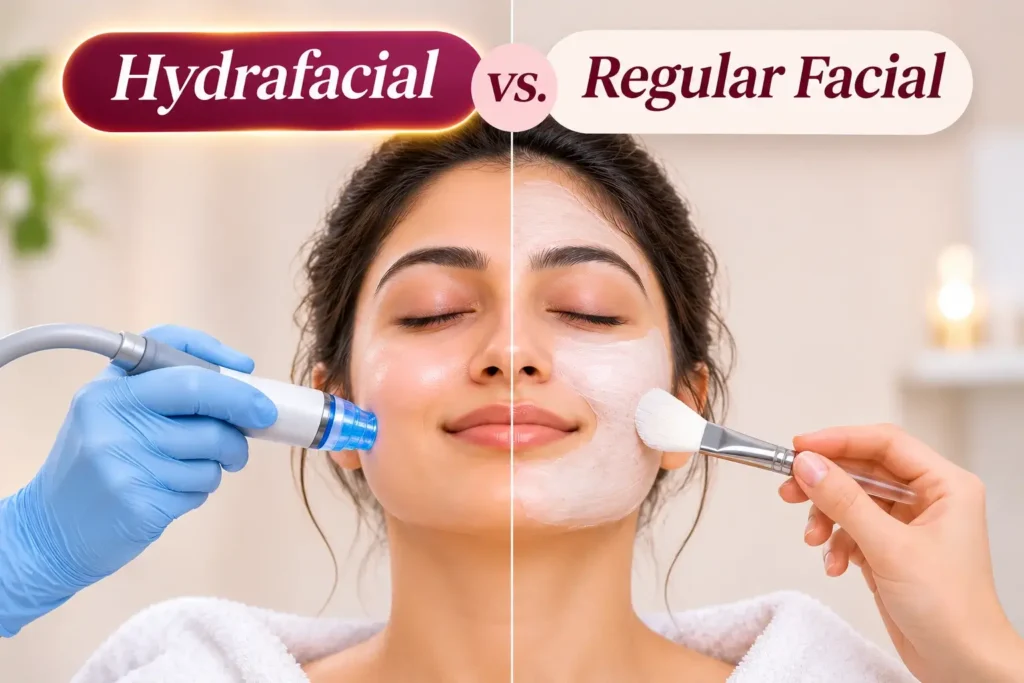
Before every wedding or festive season, my patients ask me one common question: HydraFacial vs. regular facial, which one is worth the money? Many have tried salon facials for years, some with good results and some with rashes or dark marks after bleach and scrubbing. In this article, I will explain in simple words what a HydraFacial treatment is, how it is different from a normal facial, and why getting it done at a dermatologist’s clinic makes a real difference to your skin.
What Is a Regular Facial?
A regular facial is the one most of us know from a salon or spa: cleansing, scrub, steam, squeezing out blackheads by hand, massage, a face pack and moisturiser. In many Indian salons, bleach or a “gold” or “fruit” facial is added. It is relaxing and for normal, healthy skin it can give a nice fresh look for a few days. But the result depends a lot on the person doing it and the products used. Hard scrubbing and squeezing can leave redness, small marks or even dark spots, especially on Indian skin, which tends to darken after any irritation.
What Is HydraFacial Treatment?
HydraFacial is a machine-based facial in which a special handpiece cleans, exfoliates, sucks out pore dirt and puts hydrating serums into the skin, all in one sitting. The medical name for this method is hydradermabrasion. Instead of rough scrubs and fingers, it uses a spiral tip with water-based solutions and gentle suction. A session takes about 30 to 45 minutes.
HydraFacial Treatment Steps
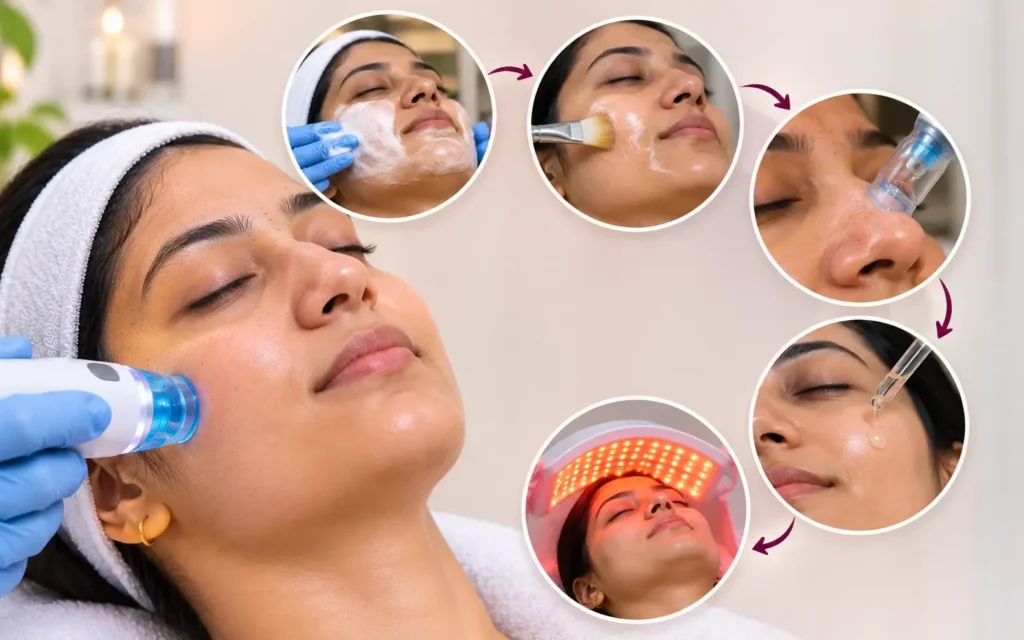
- Cleanse and exfoliate: the tip removes oil, dirt and dead skin from the surface
- Mild acid peel: a gentle solution of glycolic and salicylic acid loosens blackheads and dead cells
- Extraction: painless suction pulls out blackheads and pore dirt without squeezing
- Hydrate and protect: serums with hyaluronic acid, antioxidants and peptides are infused into the skin
- Optional add-ons: special boosters or LED light, depending on your skin
What Does a HydraFacial Do for Your Face?
After one session, most people see cleaner pores, softer skin and a fresh glow. With a course of sessions, it can help with oily skin, blackheads and whiteheads, dull and dehydrated skin, rough texture and mild tan. In a study where volunteers had six hydradermabrasion sessions, 7 to 10 days apart, skin became thicker and better hydrated, and fine lines, pore size and pigmentation reduced, with no complications. But let me be honest: HydraFacial does not treat deep acne scars, melasma or sagging skin. For those, other treatments are needed.
HydraFacial vs Regular Facial at a Glance
| HydraFacial | Regular facial | |
| Method | Machine with suction and serums | Hands, scrubs, steam, massage |
| Blackhead removal | Suction, no squeezing | Manual squeezing |
| Time | About 30–45 minutes | About 60–90 minutes |
| Feels like | Cool, wet, light suction | Relaxing massage |
| Glow lasts | Usually 1–4 weeks | Usually a few days |
| Redness after | Usually mild, settles in hours | Can last longer after squeezing |
| Best for | Oily, congested, dull, dehydrated skin | Healthy skin and relaxation |
| Who plans it | A dermatologist, at a skin clinic | Usually a beautician or therapist |
| Skin check before | Yes, at a dermatologist’s clinic | Usually not |
Is HydraFacial Better Than Regular Facial?
For most skin problems, yes, because it cleans deeper, causes less trauma and gives a more even result every time. But “better” depends on what you want.
HydraFacial may suit you if
- You have oily skin, open pores, blackheads or whiteheads
- Your skin looks dull or dehydrated, or you want a glow before a function
- Your skin reacts or darkens after salon scrubbing and squeezing
A regular facial may be enough if
- Your skin is healthy and you mainly want relaxation
- You have no acne, pigmentation or sensitivity issues
Why a Dermatologist for HydraFacial Makes the Difference
HydraFacial machines are now available in many salons, and copies of the machine are also sold. The treatment is gentle, but the right serum, peel strength and number of sessions depend on your skin. A dermatologist can also find the real cause of your dullness or pimples, such as hormonal acne, melasma or fungal infection, and treat it, instead of only giving a glow. So if you are searching for a HydraFacial dermatologist in Ahmedabad, ask which machine is used, who checks your skin and what solutions are applied. At Dermasure, our HydraFacial and medi-facials are planned after I examine your skin.
What a dermatologist’s clinic does differently
- Skin check first: your skin type, acne, pigmentation, allergies and medicines (like isotretinoin) are checked before the facial
- Right strength for your skin: the peel and serums are chosen and made milder for sensitive or darker skin that marks easily
- Clean and genuine: fresh disposable tips and sealed solutions are used for every patient
- A doctor on hand: if your skin reacts, it is treated the same day, not left to settle on its own
- One plan for your skin: the facial can be combined with acne treatment, peels, laser or boosters when your skin needs more than a glow
Side Effects, Aftercare and Who Should Wait
Most people feel only mild tingling during the peel step. Light redness or tightness can remain for a few hours. Rarely, a few small pimples or irritation may appear, mostly in very sensitive skin. HydraFacial should be delayed if you have active painful acne, open wounds, sunburn, a flare of eczema or rosacea, or a recent peel or laser. Tell your doctor if you are on isotretinoin, are allergic to aspirin (salicylic acid is related), or are pregnant, because the solutions may need to change. If your skin often reacts to products, see a skin allergy doctor in Ahmedabad first.
After the treatment, avoid heavy makeup, steam, swimming and the gym for a day, pause retinol creams for two to three days; and use sunscreen daily. Good home care is what keeps the glow going.
HydraFacial by Dermatologist Price in Ahmedabad
A regular facial at a salon usually costs around ₹2,000, depending on the products. At Dermasure, HydraFacials start from ₹2,000 per session, and medi-facials start from ₹1,000. So a medical facial at a dermatologist’s clinic costs about the same as a salon facial, but the price also includes a skin check by a doctor and a plan made for your skin. The final cost depends on add-on boosters and the number of sessions you need. For maintenance, one session every four to six weeks is usually enough; for oily or congested skin, I may suggest a short course, two to four weeks apart.
My Advice: HydraFacial vs. Regular Facial

If you just want to relax, a good regular facial is fine. If you want cleaner pores, better hydration and a safe glow without squeezing, HydraFacial is the better choice. If you have acne marks, pigmentation or scars, you may need medical treatment or face laser treatment along with it, and for deeper hydration, an injectable skin booster facial treatment can be added later. The difference is not only the machine; it is who checks your skin and plans the treatment. As a top rated dermatologist in Ahmedabad, I always check the skin first and then suggest the facial. You can book a consultation at Dermasure, Ambawadi, and see consented before and after photos of our patients.
Frequently Asked Questions
Does HydraFacial hurt?
No, most people find it comfortable. You feel cool solutions, light suction and mild tingling during the peel step.
Can I get a HydraFacial before a wedding or function?
Yes, it is a good choice. Take it 3 to 5 days before the event, and try your first session earlier if your skin is sensitive.
Can HydraFacial remove pigmentation or tan?
It can reduce mild tan and dullness over a few sessions. Melasma and deep pigmentation need medical treatment by a skin care doctor.
Is a HydraFacial at a salon the same as at a dermatologist’s clinic?
The machine may look similar, but at a clinic a doctor checks your skin first, chooses the solutions and can treat any reaction. Some places also use copy machines, so always ask which machine is used.
This article is for general information and does not replace a consultation. Results vary from person to person.