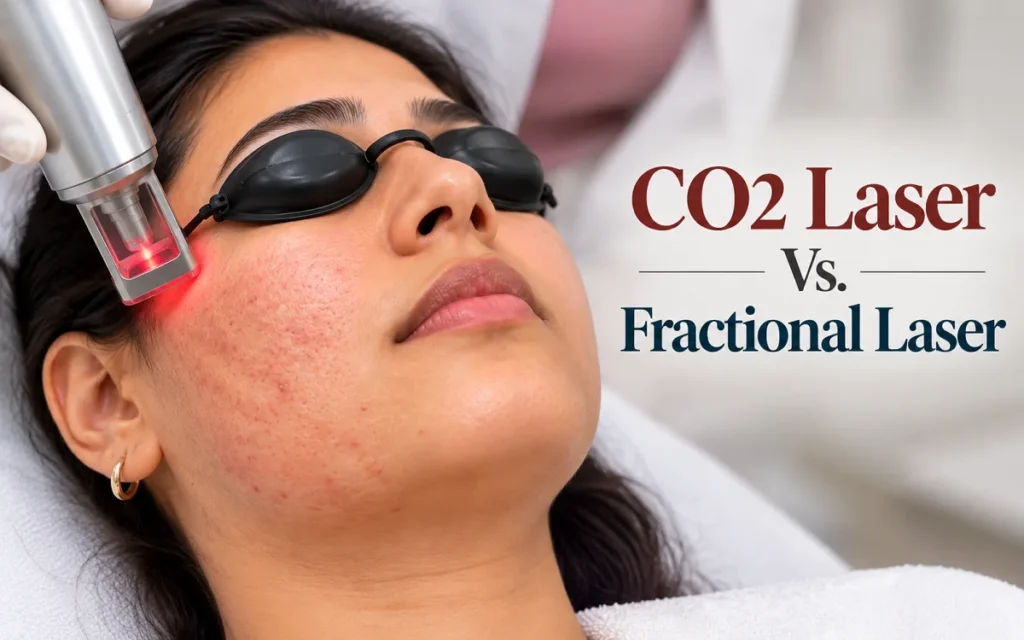
“Doctor, which laser should I take?” I hear this question almost every day. Two names come up most often: laser toning and fractional CO2 laser. Both are lasers, both are done on the face, and both are talked about for “clear skin.” But they work in completely different ways and treat different problems. In this article I compare CO2 laser vs. fractional laser in simple words, so you know what each one does, what the recovery is like, and which one suits your skin.
What Is Laser Skin Treatment?
A laser is a focused beam of light of one wavelength. Different wavelengths are absorbed by different targets in the skin: pigment, water or blood vessels. That is why one laser removes hair, another fades dark spots and another treats scars. Broadly, face lasers fall into two groups:
- Non-ablative lasers, such as laser toning, work under the surface without breaking the skin. Little or no downtime.
- Ablative lasers, such as the CO2 laser, remove or vaporize a thin layer of skin so new, smoother skin can form. More downtime, stronger results for scars and texture.
So, what is laser skin resurfacing? It is the second group: using an ablative laser to “resurface” the skin by removing damaged layers and building fresh collagen.
What Is Laser Toning?
Laser toning uses a Q-switched Nd:YAG laser (1064 nm) at low energy with a large beam, passed gently over the face several times. The light breaks extra melanin, the brown pigment, into tiny particles that the body clears slowly. The skin is not cut or peeled, so you can usually go back to work the same day with mild redness.
It is mainly used for pigmentation: melasma, sun tan, dark spots, uneven tone and post-acne marks. Most people need a course of 4–8 sessions, a few weeks apart. Toning works best along with sunscreen and creams. Melasma can come back after treatment stops, so maintenance and sun protection matter. Settings must be controlled carefully, because too many high-energy sessions can cause white patches (mottled hypopigmentation).
What Is CO2 Laser Treatment?
A CO2 laser (10,600 nm) is absorbed by the water in skin cells. It vaporizes a very thin layer of skin and heats the layer below, which tightens collagen and starts the skin’s repair process. Over the next few months, new collagen fills in and the skin becomes smoother and firmer. This is why a CO2 laser is used for acne scars, chickenpox and surgical scars, rough texture, open pores and fine wrinkles.
Fully Ablative CO2 Laser vs. Fractional
A fully ablative CO2 laser treats the whole surface of the skin in one go. Results can be dramatic, but healing takes two to three weeks, and in brown Indian skin the risk of long-lasting darkening or lightening is higher. A fractional CO2 laser treats only tiny columns of skin, with normal skin left untouched in between. That normal skin helps the treated areas heal faster, so recovery is about a week and the risk is lower. For the full face in Indian skin, I almost always use the fractional mode.
CO2 Laser vs. Fractional Laser: What Is the Difference?
Many people ask me the difference between a CO2 laser and a fractional laser, as if they are two separate machines. They are not exactly opposites. “CO2” is the type of laser; “fractional” is the way the beam is delivered.
So what is fractional laser treatment? It means the laser is broken into thousands of microscopic dots instead of one solid beam. A fractional laser can be CO2 (ablative), erbium (ablative) or non-ablative. When people compare “CO2 vs fractional,” they usually mean fully ablative CO2 versus a fractional laser. Fractional CO2 sits in between: stronger than non-ablative lasers, with much shorter healing than fully ablative CO2.
Laser Toning vs. Fractional CO2 Laser at a Glance
| Laser toning | Fractional CO₂ laser | |
| Type | Non-ablative (Q-switched Nd:YAG) | Ablative, fractional (CO2) |
| Main use | Pigmentation, melasma, tan, dull skin | Acne scars, texture, open pores, fine lines |
| Sessions | Usually 4–8, a few weeks apart | Usually 3–5, 4–6 weeks apart |
| Numbing | Not usually needed | Numbing cream for 45–60 minutes |
| Downtime | Mild redness for a few hours | Redness and fine scabs for 5–7 days |
| Result shows | Gradually over the course | Over 3–6 months, as collagen builds |
| Main risk in Indian skin | White patches if overdone; pigment can return. | Temporary darkening (PIH) after healing |
Which One Is Right for Your Skin?

Laser toning may suit you if
- Your main concern is pigmentation, tan, dark spots or melasma
- You want little or no downtime
- You have post-acne marks (flat brown spots) but no deep scars
Fractional CO2 laser may suit you if
- You have pitted acne scars, chickenpox scars or surgical scars
- You have rough texture, large pores or fine lines
- You can take about a week off from social events
Many patients need both, one after the other: first we clear active acne and pigmentation, then treat scars. If you still have active pimples, acne treatment comes first. For melasma, toning often works better combined with creams or chemical peels than on its own.
Fractional CO2 Laser Before and After: What to Expect
When you see fractional CO2 laser before and after photos, remember the “after” is usually taken months later, not the next week. A realistic timeline after one session:
- Day 0–2: redness, swelling and heat, like a strong sunburn
- Day 3–7: tiny dark dots and fine scabs appear and flake off; do not pick them
- Week 2–4: light pinkness; some Indian skin shows temporary darkening, which settles with creams and sunscreen
- Month 3–6: smoother texture and shallower scars as new collagen forms
Acne scars usually need 3–5 sessions. Scars improve, often clearly, but they rarely disappear completely. At Dermasure, I show consented before and after photos of our own patients during consultation.
Is Laser Resurfacing Painful?
Laser toning feels like light warm snaps on the skin; most people do not need numbing. For fractional CO2, we apply numbing cream for 45–60 minutes. You feel heat and prickling during the treatment, which takes 15–30 minutes, and the skin feels hot for a few hours afterwards. Fully ablative CO2 is more painful and may need injections for numbing.
Safety Tips for Indian Skin
- Do not get a tan for 2–4 weeks before treatment, and use sunscreen daily afterwards
- Stop retinoid creams about a week before, or as advised
- Tell your doctor if you have taken isotretinoin in the last six months, get cold sores, or form keloids
- Avoid laser during pregnancy, with active infection, or on recently tanned skin
- After CO2, keep the skin moisturised and avoid make-up until the scabs have fallen off
My Advice Before You Choose
The laser toning vs. fractional CO2 laser choice depends on your problem, not on which laser is “stronger”. Pigment needs toning; scars and texture need resurfacing. The cost of skin laser treatment depends on the area and number of sessions, so I explain the full course cost after examining your skin. If you are looking for a dermatologist doctor in Ahmedabad for laser, you can book a consultation at Dermasure, Ambawadi.
Frequently Asked Questions
Can laser toning remove melasma permanently?
No. Toning can lighten melasma well, but melasma can return with sun and hormones. Sunscreen and maintenance are needed.
Can fractional CO2 laser remove acne scars completely?
It can improve them a lot over several sessions, but complete removal is uncommon. Deep scars may also need subcision or other treatment.
Can I do laser toning and CO2 laser together?
Yes, in a planned sequence. Usually pigmentation is controlled first, then scars are treated a few weeks apart.
This article is for general information and does not replace a consultation. Results vary from person to person.